Showing posts with label Palestine. Show all posts

Friday, February 10

[four more days in paradise lost]

Alright, friends. We all knew this day was coming, when the adventure of Palestine would come to an end. I did not expect it to be so soon. The brief rain this morning was followed by gorgeous sun and dark clouds, and the air smelled like springtime. It smelled so familiar, welcoming, and alive -- it smelled just the way spring in Kirkland smelled.

I have come to feel about Nablus the way I feel about Kirkland and Northampton. These are places where I know people, where I have favorite places, where there are regular spots I hang out, where I have experienced the full range of emotions from lowest low to highest high. It is a place I will return to, throughout my life, I am sure.

Palestine itself has been welcoming and challenging and inspiring and educational. 'Nothing in the guidebooks is true but the maps,' said Dave Eggers in You Shall Know Our Velocity. That's certainly true in this part of the world, except that depending on who you ask, even the maps aren't true.

I am confident that Palestine and my friends here will always hold a special place in my memory, and in my future. We're not done yet, Palestine. I'll see you soon. Thanks for the ridiculous amount of life experience you've managed to cram into four months. It's been real.


Friday, February 3

[al-quds in february]

I'm currently camped out at the Austrian Hospice in Jerusalem's Old City. This is where my grandfather and I will spend the night this evening before migrating to Nablus tomorrow so I can be back in time to help administer the first adult choir rehearsal.


It was fairly sunny and breezy on the way over from Nablus and through Ramallah. My favorite kind of weather. The apartment gets pretty cold at night, but when I'm out walking and the sun is on my face and my feet are moving, it's not too bad. I am also really grateful that the weather is dry today -- a rainy day would have made the meeting up with my grandfather even more tricky and potentially unpleasant.

We'll spend one night here in the Hospice, explore the Old City tonight and have dinner and do a nice walk around the area tomorrow morning before heading back to Nablus tomorrow around lunchtime.

Speaking of which, his plane landed about an hour and a half ago, and depending on how long it took to get through security and how long the shared taxi service is taking, he could be arriving at our meetup point anytime. I think I'll migrate over there and have some tea and write some letters in the meantime. Not looking forward to shimmying and shoving my way through the crowd around Damascus Gate again.

Wish me luck!

Wednesday, February 1

[grandpa comes to palestine!]

Folks, I have an announcement to make. In spite of the rainy weather, the 11 hour flight, the horrendous security checks and the multi-transfer journey from Tel Aviv to the West Bank, my grandfather is coming to Palestine tomorrow.

He is well-read, well-traveled and incredibly enthusiastic about this trip. He's wanted to visit this region of the world for quite some time, and now that his granddaughter (me) is living and working here, the timing is right!

My to-do list for his visit:

  • Jerusalem/Al-Quds: Old City, all the associated churches, mosques, Wailing Wall, museums, delicious dinner out
  • Bil'in: Friday weekly non-violent protest
  • Bethlehem: Church of the Nativity, Dheisheh camp, cultural centers, the Wall and Banksy graffiti, visit my favorite mosque (Mosque of Omar) on the main square, Palestinian Heritage Center, potential hike around Mar Elias and the orthodox monastery, Holy Land Trust?, Taybeh beer, Stars & Bucks cafe
  • Nablus: soap factories, Ali's oud workshop, dinner with Music Harvest folk, Sameh's piano workshop, tea at the Hijjawi dress shop, dinner with Haneen, Old City knafeh, An-Najah University, visit olive groves, Salem village, Balata camp, Sama Nablus, soccer game?
  • Hebron/Al-Khalil: Tomb of the Patriarchs, souq and abandoned main street, Breaking the Silence tour or Green Olive tour, Hirbawi kuffiyeh factory
  • Jenin: Freedom Theatre, dinner with friends
  • Ramallah: Arafat's grave and Muqata, nice dinner out
  • Jericho: gentle walk around the city
  • Maale Adumim? Ariel? http://www.toursinenglish.com/2008/01/israel-west-bank-palestine-alternative.html?
In other news, I'm ready to be onto the next thing. Good thing I have a few months to wander around before Japan in May.

Ahlan wa sahlan, Ba!

Wednesday, November 23

solidarity: now and always, here and everywhere


Bil'in Village, West Bank, Occupied Palestinian Territories.


Great things are happening all over the world. Oakland, Bil'in and Springfield are excellent examples.


What does solidarity mean? Solidarity means resistance. It means acting together. It means drawing inspiration from one another. Sharing ideas and being creative. Making change. Never forgetting that we belong to one another. And that another world is on her way, and if we're quiet enough, we can definitely hear her breathing (Arundhati Roy).


Solidarity can be dangerous.

From the 1999 Seattle WTO riots.


The shape, texture, and purpose of resistant is different for every community. But resistance to unjust systems and laws is always necessary, and always requires great courage.


This video, of friends and colleagues in Massachusetts, inspires me to take more direct, nonviolent action against the illegal and undignified occupation of Palestine.


What are you working on?


What inspires you?


What does solidarity mean to you?


Tuesday, October 25

[palestine: ahlan wa sahlan]


Life in Palestine goes one. People go to work, children go to school, and the occupation continues. If you stay in one place, you don't directly encounter the occupation. But the effects are clear.


Poster, Old City, Nablus, Palestine.


'Made in USA', Separation Wall, Bethlehem, Palestine.


Separation Wall, Bethlehem, Palestine.


Handala, Separation Wall, Bethlehem, Palestine.


Separation Wall, Bethlehem, Palestine.

Sunday, October 2

[sumud: resistance]

I have been in Occupied Palestine for a week and a half now. And it's glorious. People are friendly, the landscape is positively incredible, the food is delicious, the Arabic gorgeous and nuanced, and my work is challenging and fulfilling. I am teaching music (voice and piano) to kids in individual lessons at a music center in Nablus, and we begin group music classes at a local primary school tomorrow.


I have passed by many checkpoints, but only gone through two of them. One was unmanned and I walked through the maze of turnstiles, and other was manned by a barely legal Israeli girl who giggled and flirted over the loudspeaker with the male volunteer with whom I was traveling. There was also a gruff 30-something man who simply waved me past when I flashed my U.S. passport.

I spent hours walking along the separation wall in Bethlehem and trying not to tear up at the graffiti (pictures to come). I also picked up a fabulous book called 'Challenging the Wall: Towards a Pedagogy of Hope' which contains case studies, academic analysis, interviews, etc., about the separation wall and it's role on the Israeli-Palestinian conflict.


I crossed into "East Jerusalem" from "West Jerusalem" and the discrepancy was shocking. One crosses the street near Damascus Gate (Bab el-Aamoud) and immediately the signs are in Arabic and the voices speak Arabic.

So far I've managed to figure out how to take a serveece (like a cross between a taxi and a bus), order my daily felafel sandwich, and talk to my kids to see how their days have been. I also know my way around the Old City, how to cook in a gas-lit oven (my cake turned out fabulously), and how to ignore the 'how are yous' and the 'what's your name' and the 'i love yous' shouted at me from all directions whenever I walk down the street.

Crazy adventures:
-hiking Wadi Qelt near Areha (Jericho) at sunrise
-making friends with the owners/10-month old daughter of the restaurant in Areha
-being invited for tea by the neighbor kids, which turned into dinner, which turned into shisha on the roof
-baking/inventing a delicious cake in our gas-lit stove
-stumbling upon the PLO Negotiations headquarters, eating lunch there, and then forcing the guards to take my cake
-being in the main square of Nablus during the rally when Abbas was speaking to the UN
-observing the Via Dolorosa walk in the Old City of Jerusalem
-sharing a seat with an older woman and her granddaughter on a serveece to Ramallah
-leaving the Bethlehem Couchsurfer host's place at 3 AM and wandering around the city
-befriending four policemen in Bethlehem and being invited to cook lunch with them in their bachelor pad across from the Church of the Nativity
-leaving my mark on the separation wall

And three more months to come!

Palestine is a beautiful country. It is NOT scary. It is NOT dangerous. It is NOT full of Muslim terrorists.


...it's full of Jewish terrorists. Not that all Jews are terrorists, and not that all Israelis are terrorists. But the people in Palestine who are terrorizing Palestinians are Jewish Israelis.


It's full of Israeli teenagers toting guns, as well as armed Jewish settlers who assault regular Palestinians on a daily basis. It is also full of American-financed systematic oppression and intimidation of an entire people. It is full of brave, persistent, courageous, normal families whose every breath constitutes an act of resistance. Many people have made a choice to stay here in Palestine, or to immigrate here, to an occupied territory where their very lives and the lives of their loved ones are threatened and where their existence is denied by major players in the international community.

Palestine is a peaceful place. People are tired of violence, but they are actively demanding their right to self-determination regardless of what international leaders, Palestinian leaders, and Israeli leaders are doing behind the scenes.

One can understand nothing about a place until it is experienced for oneself, and that understanding will change every minute as the situation itself changes. Palestine is not static. Palestine is dynamic, in constant change and adaptation with the requirements of daily life and the whims of the State of Israel as well as the ignorance and cowardice of the international community.

Visit Palestine! Or at the very least educate yourself. There's so much to love here.

Wednesday, July 13

[khaled jarrar and the palestinian passport stamp]


News has spread quickly about artist Khaled Jarrar and his unofficial Palestinian passport stamp.

The Christian Science Monitor, NPR, CNN, and innumerable blogs and Facebook groups (including "Live and Work in Palestine") have covered the story of the stamp.

Jarrar has also taken his stamp on the road, including Corfu and Amman. On July 18th, the artist will also make an appearance at the historic Checkpoint Charlie in Germany to offer the stamp in a symbolic acknowledgment of Palestine's place among the occupied and oppressed nations of history.

What effect, if any, will this courageous act of nonviolent resistance from the Palestinians have on their upcoming bid for statehood at the United Nations in September? Will we see more acts designed to raise visibility and awareness of the Palestinian cause in the coming months?

Regardless, Jarrar's stamp merits recognition as not only a beautiful piece of artwork, but a growing symbol of the beauty, courage, and sophistication of the Palestinian people.


Tuesday, June 14

[arrested jewish-american lucas koerner talks to electronic intifada]


Lucas Koerner's (mentioned in previous post) interview with Electronic Intifada was released today.

Read it here

(from the Facebook page, We are all Lucas Koerner)


Here are some highlights:


"I was taken to a police station right afterwards, where I was held for about four hours before I saw a lawyer. I was threatened numerous times with being tased and being put to sleep by various weapons they had."


"What struck me most about my time in prison is that it is a reflection of the rest of Israeli society in that it's completely segregated. I was placed against my will in the Jewish cell. I asked to be put in the Arab cell. The Jewish cell conditions weren't bad at all; it was still jail, but it was bearable. I did see the Arab cell or at least one of the Arab cells and the conditions there were absolutely abominable."


"I received no support from the US consulate. My friends and family had contacted them and, from what I heard, they basically said that this happens a lot and there's nothing [they] can do. They didn't even come to my trials."


"The Israeli judicial system is very strange in that you can't have a lawyer while being questioned. ...there are no laws within Israel that prevent you from being almost indefinitely detained before being charged. I was never formally charged but I was detained for two days."


Monday, June 13

[the statement in the stamp]


Several sources around the web have published that a Palestinian art student named Khaled Jarrar has taken it upon himself to create a Palestinian passport stamp.


A gorgeous (in my opinion) design, the stamp is offered purely for symbolic purposes. It is also a compelling, highly visible act of nonviolent resistance to the Israeli occupation of Palestine. Jarrar is reported to approach foreign tourists as they exit buses in Ramallah, politely explain the purpose of his stamp, and offer to stamp passports. Some folks have been nervous about being questioned upon their departure from Israel, and others have enthusiastically handed their passports over to be stamped.

Jarrar set up this Facebook page to explain and support his idea.

The use of art, design, fashion, etc., can be powerful tools for any movement, and Jarrar is clearly utilizing local and international networks to connect with a large audience and share his dreams for an independent Palestine. Said Jarrar,

"Around 20 activists from several European countries expressed their readiness to work as volunteers to help me publish my stamp all over the world and advocate the campaign to other countries."

It is possible that Jarrar's act will inspire controversy among Palestinians and among Israelis. There is potential for administrative drama -- an unofficial passport stamp, not endorsed by the Palestinian Authority? Imagine the frustration and puzzlement for Palestinian officials.

Imagine an Israeli checkpoint inside the West Bank. Though Jarrar's stamp is harmless, it has the potential to inflame the Israeli administration and public imagination as well. A confused IDF soldier is a dangerous soldier, and this stamp may befuddle and/or aggravate Israeli soldiers, leading to increased human rights abuses toward Palestinians or those who hold passports with Jarrar's stamp. It's a long shot, but a Palestinian passport stamp may also arouse the suspicions of the Israeli administration, who could interpret the stamp as a precursor to a Palestinian revolution or the third intifada.

(on a separate note, recent polls indicate that the majority of Palestinians and Israelis do expect a third intifada)

However, Jarrar's stamp is a courageous act of beauty, creativity, and resistance. This sort of engagement and visibility is exactly what oppressed communities around the world can count on to make international headlines.


Saturday, June 11

reading list


I, probably like many of you, am guilty of creating massive reading lists including some works that interest me greatly and others that would be 'good' for me.


Below is the current version of my topic-specific reading list. Feel free to leave your suggestions in the comment box, or email them to smthgrlo@gmail.com!

  • Rediscovering Palestine
  • The Economics of Women & Work in the Middle East
  • The Political Economy of Regional Cooperation in the Middle East
  • Economic & Political Liberalization in the Middle East
  • Rebuilding Devastated Economies in the Middle East
  • The Economics of Middle East Peace
  • The Arab Minority in Israel's Economy
  • State Practices and Zionist Images
  • Islam & the Political Economy of Meaning
  • Desiring Arabs
  • In Quest of an Islamic Humanism
  • The Dynamics of Neutralism in the Arab World
  • Overstating the Arab State
  • Belated Travelers
  • Nationalism in a Non-National State
  • A Compassionate Peace: A Future for the Middle East
  • Conflict Management in the Middle East
  • The Politics of Sacred Space: The Old City of Jerusalem
  • Negotiating Jerusalem
  • The West Bank Handbook
  • Crossing the Green Line Between the West Bank and Israel
  • The Yellow Wind
  • The Third Way
  • The Others Within Us
  • Strengthening Palestinian Public Institutions
  • Displaced at Home: Ethnicity & Gender Among Palestinians in Israel
  • A Voice of Reason
  • Genealogies of Conflict: Class, Identity, & State in Palestine/Israel and South Africa
  • Arab-Israeli Conflict: Psychological Obstacles to Peace
  • Israeli and Palestinian Narratives of Conflict
  • Practical Peacemaking in the Middle East
  • From Confrontation to Cooperation
  • The One-State Solution
  • Occupied by Memory: The Intifada Generation & the Palestinian State of Emergency
  • Bridging the Divide: Peacebuilding n the Israeli-Palestinian Conflict
  • Holy War, Holy Peace
  • Israel & the Palestinians: Israeli Policy Options
  • Palestine Inside Out
  • The End of the Peace Process
  • Disenthralling Ourselves
  • Nakba

Looking forward to lots of library time this summer! What books are you reading?

[the vernacular of the visionless]

My alma mater, Smith College, is currently hosting a small group of current students in Israel for a summer of participation in one of several Global Engagement Seminars. Students are invited to contribute to an official Smith blog as they travel, expand their horizons, complete internships, and talk with the locals.

A few weeks ago, an entry was posted titled "Words Matter," by Katy Swartz, '13. The piece discusses the use of the word 'apartheid' in describing contemporary Israel, and the author believes that 'apartheid' is an inaccurate and damaging characterization of Israel's policies. She cites a letter from the Vanguard Leadership Group that states,

"The use of the word 'apartheid' by Students for Justice in Palestine (SJP) in its characterization of Israel is patently false and deeply offensive to all who feel a connection to the state of Israel. Your organization's campaign against Israel is spreading misinformation about its policies, fostering bias in the media, and jeopardizing prospects for a timely resolution of the Israeli-Palestinian conflict."

I'm going to re-state her main points, and show where Katy has gone wrong.

The main points, as I understood them, were that 'apartheid' cannot be applied to Israel because of the following reasons:

  • 'Apartheid' refers to race, and "Judaism is not a race"
  • 20% of Israel's citizens are Arab, and they have "full and equal rights under Israeli law"
  • If Israel were racist against Arabs, it would not act justly toward its own Arab-Israeli citizens on the one hand, but unjustly toward Arabs and Palestinians elsewhere
  • Self-governance, as the author defines the presence of the Palestinian Authority in the West Bank and Gaza, would not occur under apartheid
  • "An apartheid regime would...[wish] to remain sovereign over the group it were oppressing because it would likely be benefiting from the forced labor of the citizens"
The author also makes the following (I think, problematic) statements:

  • Palestinians were offered a two-state solution and rejected it; as such, they are implicitly to blame
  • Palestinians were offered citizenship in East Jerusalem and "refuse[d] to participate in the city government"
  • "Israel is still committed to the establishment of the state of Palestine in the Palestinian territories"
  • Israel's recent 'control' policies are "a result of Palestinians blowing up innocent Israeli civilians (which of course did not happen in South Africa)"
  • "Israel remains dedicated to finding a solution within the parameters that allow for the Jewish state to remain in existence alongside a future Palestinian state"
Well. Let's unpack some of this, shall we?

First of all, some background on the author:

Katy Swartz will be a junior at Smith next year, self-identifies as an orthodox Jew, and is a Jewish Studies major at Smith. By no means am I claiming that Jews are innately unable to make valid contributions to this conversations (and, as Lucas Koerner proved, Jewish ethics can be a large motivating factor to stand with the Palestinians), but I believe that knowing an author's background is an essential part of understanding their belief system and teasing apart their biases.

She is on this summer program with other Smith students of varying opinions and identities surrounding the conflict. I'm sure the experience may at times feel threatening to her beliefs and her identity. I applaud Katy for attempting to engage in these difficult conversations, and for making public her opinions and her frustrations.

Katy was raised in a Jewish household (see above interview) and I have seen her, along with other student members of the Smith Israel Alliance, at many related events on campus. I particularly remember her presence at a presentation by scholar and author Norman Finkelstein on campus in Spring 2011. She and her peers put up posters from CAMERA on the doors to the venue where Finkelstein was speaking, and handed them out to folks as they entered the building.

These fliers are despicable, shabby, inaccurate, discriminatory pieces of literature with a Zionist agenda and absolutely no constructive or intellectual value, in my opinion, and in the opinion of others, including Uri Strauss with the Palestine Action Coalition (see his piece on apartheid and Israel here and note his comment on Katy's post here).

Here's the flier (from CAMERA)... And here's Finkelstein (from his website)


The flier from CAMERA purposefully utilizes a photograph of a gun-toting, turban-wearing, bearded Arab man for shock value, and coercively manipulates the viewer into associating Finkelstein with the fear and hatred of 'the Arab'. It utilizes the color pink in a way that suggests that Finkelstein is effeminate or gay, and subversively uses homosexuality as a reason to discredit Finkelstein's academic and intellectual value (indeed, when typing 'Norman Finkelstein' into Google, 'Norman Finkelstein gay' pops up). More crucially, the flier contains biased sources and surface-level answers that are absolutely inappropriate and disrespectful to the event and to the speaker and the hosting organizations. I hold anyone who hands out these fliers responsible for their message.

Uri Strauss, currently the Law Fellow with Western Mass. American Friends Service Committee, published an article in 2002 titled "Defining Apartheid: Israel's Record." Strauss points out that 'race' is widely interpreted under UN Conventions, and would include Jews as a race. We cannot use the technicality of language to allow occupiers and human rights abusers to escape responsibility. I would suggest that perhaps genocide is a more accurate description, as defined by the 1948 UN Convention on the Prevention and Punishment of the Crime of Genocide, Article 2:


Whether or not Judaism is considered a race, Israel is still upholding blatantly discriminatory and abusive policies.

Katy's second point about the "full and equal rights under Israeli law" for Arab citizens of Israel is simply incorrect. The Arab citizens of Israel have been subject to consistent and repressive policies since the founding of the state of Israel, including land grabs, racist laws, home demolitions, forced migration (see this article from Middle East Monitor). Even if Arab citizens of Israel were treated like royalty, this has no bearing whatsoever on the treatment of other Palestinians within the borders that Israel currently claims.

Her next point (that a racist regime does not pick and choose where it practices racism) is ridiculous. Any racist act by a regime means it is a racist regime, in the same way that "injustice anywhere is a threat to justice anywhere" (Dr. Martin Luther King, Jr.). Sure, everyone's a little bit racist sometimes from a sociological perspective, but we're not all committing systemic genocide on a societal level.

Katy also states that self-governance would not occur under apartheid. Firstly, self-governance can absolutely occur under apartheid (Bantustan, anyone?). In addition, the Palestinian Authority has been perceived by Palestinians to be corrupt, unrepresentative, and unsupported and disrespected by the majority of the outside world. The PA may wear the mask of self-governance, but it does NOT represent genuine self-governance.

She also makes the point that an apartheid regime would wish to remain sovereign over the oppressed group to benefit from its forced labor. Israel either DOES implicitly benefit from cheap Palestinian labor, with crowds of men sitting near roads hoping to land a temporary menial labor job with a passing Israeli, OR the ridiculous permit system in combination with checkpoints prohibit Palestinians from having good jobs within Israel or within the Occupied Palestinian Territories.

For me, Katy's analysis relies on a lack of historical understanding of what power dynamics, collective memory, cultural narratives, and 'resistance' mean, and more specifically what these terms mean to Palestinians. Decades of mistreatment and neglect from the majority of the international community have created generations of Palestinians that are struggling with notions of identity and homeland. Many Palestinians still hold the deeds to land inside Israel. Millions of Palestinians have been born outside the holy land, but still identify with the history, the myth, and the physical place of Palestine. Without a fully functioning, recognized, supported government, and subject to all forms of economic sanctions, physical and mental abuse, I wonder how Katy recommends that Palestinians reconcile their past, their present and their abusers, and their dreams for a future.

Arundhati Roy describes it well, saying

"Can the hungry go on a hunger strike? Non-violence is a piece of theatre. You need an audience. What can you do when you have no audience? People have the right to resist annihilation."

Palestinian suicide bombers are resisting occupation and humiliation. I do not condone violence against anyone or anything, but I understand why certain parties are behaving and reacting in the ways that they do; as Arundhati Roy says, they are 'resisting annihilation'.

Katy also explains that Israel is not committing the crime of apartheid, but rather utilizing 'control' strategies as a result of "Palestinians blowing up innocent Israeli civilians." The destruction of human life (or animal life, or natural forms of life, in my opinion) is never desirable. But we must call a spade a spade. Or it's not quite a spade, let's call it 'frustrating' and 'harmful' if we don't have the right words to describe it.

In the end, we can all agree that something is clearly wrong in the holy land, and we are all responsible for what has happened in the past and for what will happen in the future. We are all complicit parties to this conflict, until it is resolved. No one -- neither Israelis nor Palestinians nor aid workers nor tourists nor Druze, etc. -- feels secure, and everyone deserves that right.

I believe it is possible to achieve a satisfying, secure outcome for all parties, and that the first step is to watch our language and listen to each others' stories. But as long as the vernacular of the visionless presides, there will be neither peace nor justice in the Holy Land.

To Katy (and others reading this), this is not meant to be a personal attack, and I do apologize if it feels that way. If you're reading this, I'm interested in hearing back from you. You can post a comment or email me at smthgrlo@gmail.com, and I promise to respond respectfully and promptly.

Friday, June 10

[the profane in the holy land]


I've spent the last few weeks trying to gain a better understanding of what daily life in Palestine is like. From everything I've read thus far, it seems to me that the Palestinian experience and identity is shaped not only by a shared narrative and intense collective memory, but also by interactions with the 'Other'. In this way, Palestinians define themselves, but Israel, or opposition to Israel, also defines Palestine.

Israel claims a monopoly on legitimacy, politics, resources, morality, and international support. I recently stumbled upon an article with an accompanying video that I'd like to share: http://ht.ly/5eyth ("Israeli police wrestle US citizen to ground, put knee on his neck," from electronicintifada.net).

The video includes 19 year-old Lucas Koerner's explanation for his presence at the rally, and shows footage of at least three Israeli police roughly pushing Koerner to the ground and pinning him down beneath their knees as they handcuff and carry him to their vehicle.

(Lucas Koerner, from electronicintifada's article)


From what I can tell, the young man (American-Jewish) was being a nonviolent presence and standing in solidarity with the Palestinians at an Israeli settler rally on Jerusalem Day earlier this month. He had affixed a Palestinian flag to his kippah and another to his keffiyeh. The video showed the clear transition from surprise to confusion to anger at this seeming clash of symbols. As the young man stated on his blog,

"For them, Judaism and its physical symbol, the kippah, were inseparably bound up with the particular strain of ethno-religious nationalism associated with the state of Israel. It simply never occurred to them that a Jewish person would, in the name of Jewish ethics, stand in solidarity with the oppressed Palestinian people in their struggle for freedom. I feel that it was precisely this cognitive dissonance on a societal level that formed the motivation for my arrest."

I am interested in identity formation at the societal/communal level and how such an identity can aggravate conflict or set the stage for peace. Koerner mentions the conflation between national and religious symbols in mainstream Israeli identity. Israel is guilty of portraying Palestinians as hopelessly fused with Islam, fundamentalism, and terrorism. And it's not alone.

Not all Jews are Israelis, and not all Israelis are Jewish. Not all Palestinians are Muslim, and not all Muslims are Palestinian. It may sound ridiculous to state such obvious facts, but the way that we characterize, conceptualize, and use our language to frame a situation have great impact on how we perceive the participants, behavior, and possible solutions.

It's not about anti-Semitism. It's not about Arab terrorism. It's not as simple as Israelis versus Palestinians. Those categories are so much bigger and more complex than a single person, a community, a religion, or a state.


Sunday, May 29

[the beginning in the end]


Hello friends,

Apologies for the ridiculously long absence from manysunsets. My life has been quite a story since I last wrote -- I had a fantastic senior year at Smith College. I spent Christmas in Strasbourg with my dad and his girlfriend and her family, and then spent my 21st birthday in Seattle with my most wonderful friends.

I have been an alum of Smith College for two weeks now. I am surprised at how much better it feels to be graduated than I anticipated. I feel very free. I feel less guilty about how I spend my time. I permit myself to dream, to read travel blogs, to start my never-ending reading list, to drink iced tea and grilled cheese sandwiches on gluten-free bread all day. And I can now submit applications for jobs and positions for which I was previously ineligible or 'unqualified'.

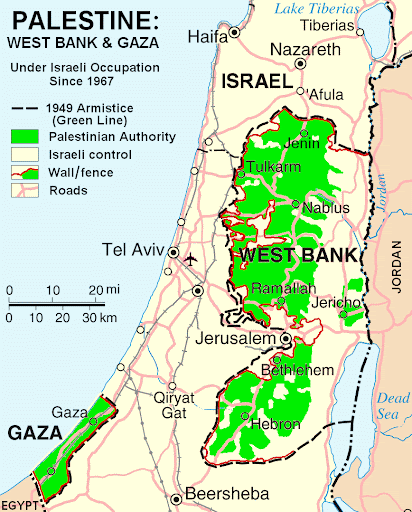
One of those applications was for a three-month position teaching music with an organization in Nablus (in the West Bank in Palestine -- see map below) called Music Harvest. I was confident that I'd submitted a strong application, and was pretty happy with how my Skype interview went. Lo and behold, last week...

I got an acceptance email!

So. Though I have not officially accepted (I will most likely do so next week), my heart is set on accepting the post. I will be teaching voice and piano to Palestinian students between ages 5 and 15 in the city of Nablus, إن شاء الله.

Nablus is a fairly conservative Islamic city -- not as conservative as Saudi Arabia -- and has been a center of Palestinian resistance to the Israeli occupation. There are several refugee camps in the West Bank, and many landmarks of religious importance to multiple faiths.

Nablus is home to Jacob's Well and is well-known for soap-manufacturing, kanafeh (a sort of pastry), olive oil, furniture, and other handicrafts. It is also home to the Palestine Securities Exchange (the only one in the Palestinian territories).

Wikipedia informs me that one of Nablus's sister cities is Dublin, Ireland -- many folks, including myself, have drawn comparisons between the way that the Ireland/Northern Ireland and the Palestine/Israel conflicts have been framed, both by outsiders and by parties to the conflicts. Obviously, the two conflicts are multifaceted and incomparable on many levels, but the discussions of national identity, occupation, statehood, armed resistance and terrorism, religion, and economic status have sometimes echoed each other. Not only is Dublin a sister city to Nablus, but many Palestinian flags have been flown in republican areas of Ireland in contrast to Israeli flags in the unionist areas of Northern Ireland.

Anyhow, I am now beginning the mental, physical, and material preparations for going to the West Bank in September.

Now, I bet some of you are thinking something along the lines of, "why would a nice, young, blonde girl like yourself want to go live in a war zone?" And indeed, my father's first question was, "is it safe?"

While there are so many politically charged, rambling, ranting answers I could give to the assumptions and power dynamics behind that question... Fair enough. I expect to encounter, directly and indirectly, armed and nonviolent Palestinian resistance to the Israeli occupation. I also expect to encounter informal and systemic violence against the Palestinian community coming from some of the Israeli community.

I've done quite a bit of traveling -- granted, none of it in a place quite like Palestine -- and I have a great deal of common sense, highly attuned instincts for when to trust someone, when to back away with a smile, and when to throw an upper-cut. From all the research I've done thus far (including blogs, chats with trusted friends/professors, news articles), it seems that violence in Nablus and in the West Bank has been changing its face in the last year or so. Though violence and public opinion are unpredictable (especially because public opinion is not homogenous nor representative of the entire Palestinian community), it also appears that foreigners are generally welcomed and respected, or at least left untouched, particularly if they have connections within the community. I plan on using my identity as a sweet young female self to my advantage while I'm there -- accepting dinner invitations from families of students and asking for help from trusted sources when I need it.

This org will house me with the other volunteers, and I'll pay for my own living expenses (like food and local transportation), which they estimate to be about $50 per week. I'm also hoping to do some traveling when I'm not working. I'm especially looking forward to Lebanon, and hopefully Syria if shit doesn't seriously hit the fan.

Mainly, I want to go because I need to see Palestine with my own two eyes. There is something inside me that feels an affinity with the Arab world: the misinterpretation and subjugation by colonial powers and neo-colonialism; the struggle to define a national identity after a history of occupation; the collective memory of war and peace, family and foreigner, music and art, home and displacement; and the pride, patriotism, pacifism, and perspicacity of the majority of the Arab world.

I also feel an obligation to defend human rights, including basic security of self and property, the right to self-determination, and a genuine voice in the governing political body. Much has been said about Palestine by all kinds of people. I hope to find a balance between the learning I will do with my eyes and heart and ears, and the learning I have already acquired through my coursework, newspaper articles, speakers, and conversations.

I am mostly going to learn -- to hear stories. This is something I learned during my training two weeks ago to be a social justice mediator. The technique I was trained in asks mediators to gather stories from each party, and then to simply transmit the stories to the other parties. No seeking of common ground, no editing, no bargaining chips. I hope to practice this method in Palestine.

I am also going because I love music and I love working with children. I have experienced the transformative power of music, and I know how empowering it can be to acquire proficiency on an instrument and to be able to learn songs that the student is actually interested in, and to have the ability to perform together with my friends or with strangers. I hope to provide a safe, engaging, challenging, creative space for my students in which no questions are off-limits and in which the student is not only a music student but also a human being with a unique story and unique needs and dreams.

End the sappiness.

Here are the practicalities of preparing:

-Applying for a second passport so that my Israeli visa doesn't prohibit regional travel

-Reviewing my Arabic notecards and making specific vocabulary lists for teaching music, daily usage, and Palestinian Arabic in particular

-Finding a language partner (in person or on Skype) to practice speaking Arabic

-Finessing my packing list (including lots of long skirts, ear plugs, gifts)

-Reading (currently on "I Saw Ramallah" and the Holy Qur'an -- yes, it's online, just like the Bible)

-Preparing to teach:

-Reviewing my music theory

-Learning some Smithereens arrangements (Peace Pipes ?!)

-Chatting with mom about teaching techniques and strategies

-Practicing the piano

-Making a list of artists, genres, arrangements, songs that a) I want to introduce to my students, and b) are well-known in the region with which I want to be familiar

-Earning some money to pay for this exciting adventure!

-Planning my summer and the visits I want to make before leaving

-(sounds morbid, but...) Making a plan in case something does happen to me while I'm there.


How would you prepare for a trip like this? Are there any books or websites you'd recommend for me?